
What is a panel?
A panel is an array of PCBs that allow more than one board to be built at the same time. A panel is also used for odd-shaped PCBs to be processed on a conveyor without the use of custom fixtures. Panelizing your boards streamlines the SMT assembly process, allowing us to produce more boards in less time—resulting in faster turnaround and lower manufacturing costs for the customer.
When is it nice to panel?
- Quantities are more than 20
- PCB is round or is not rectangular.
When is it very desirable to panel? If any of the below are true:
- Quantities are more than 50 (Required for all Short-Run Orders)
- Or SMT Parts are located less than 6mm to the edge of the board
- Or PCBs are less than 55mm (1.9685 inches) long in any dimension
- Or PCB area is less than .75 square inch
When is a panel required?
- For all Short-Run orders
When is a panel not required?
- The single PCB area is more than 40 square inches
- The design already has a panel defined in its data
- The cost of panelization or tooling required to depanel is cost prohibitive.
- In this case, the board design will need to be taken into consideration and will require review and feedback from our engineering team.
How many boards to put into a panel?
It depends on the size of the PCB, and complexity of the packages on the PCB.
- Ideal panel size is 9"x11"
- Min panel size is 3"x3"
- Max panel size is 14"x19" (Larger panels will require a discussion with our engineering team)
We Prefer no more than 50 boards per panel. This reduces the chance of defects being duplicated.
- If the boards are already designed and cannot be changed, we may need to discuss options for building your boards.
The fab manufacturer makes their panels in larger sheets, usually 12"x 18" or 18"x 24". Take this into account when designing your panel. Reducing waste, thereby possibly reducing cost, is something to be taken into consideration and may be worth discussing with your fab manufacturer. That stated, the 14"X 19" limit still applies.
Examples of Complex designs that should be kept to 6 or less per panel:
- Designs that have more than two components with pitches less than .4mm
- Leadless parts such as QFNs, LGAs, BGAs, and Bluetooth-style modules
- The assembly has an expensive part or a part that is difficult to acquire
- Long lead times or only enough supplied for the build
- Custom parts
- Over $150 per part
Depaneling methods:
V-score is the most desirable method for separation between PCBs. This is the quickest way to separate and leaves a clean board edge. See examples below.
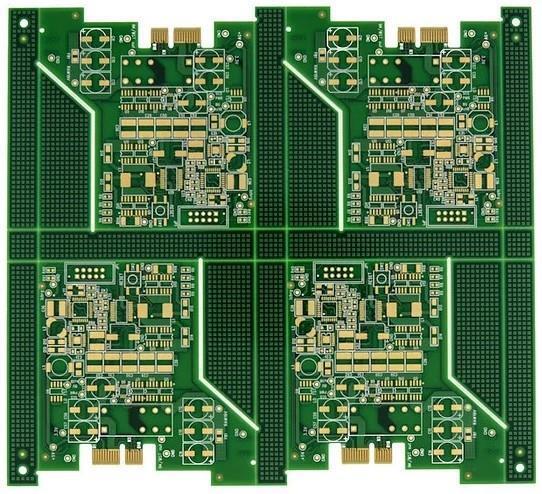
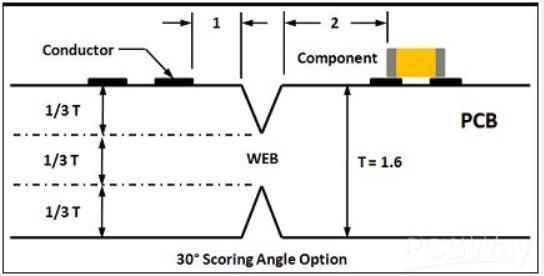
When choosing V-score, it's important to ensure that there are no parts next to or overhang the V-score grove that may interfere with the depanel operation. This method of singulation uses a circular blade that moves along the grove and cuts the remaining material. Parts that hang over the V-score or are up next to it can be damaged during depanel and need to be taken into consideration during panel design.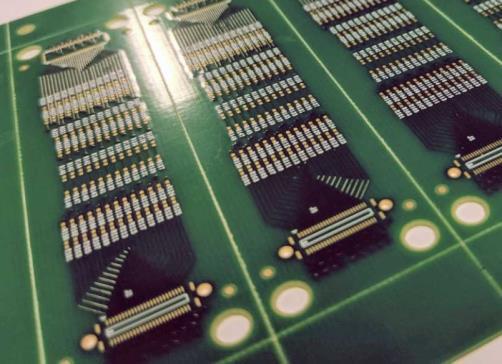
Route tab is best when there are no straight edges for v-score. It does take significantly more time than v-score to separate. It also can leave an uneven edge. See examples below
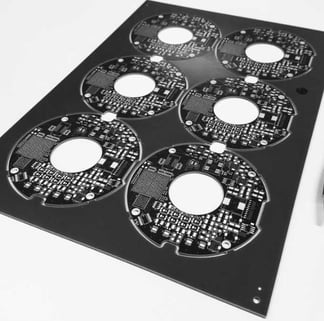
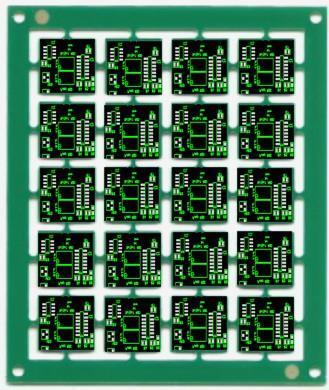
Important: Route paths need to be made no less than .050" wide
Addition of panel rails:
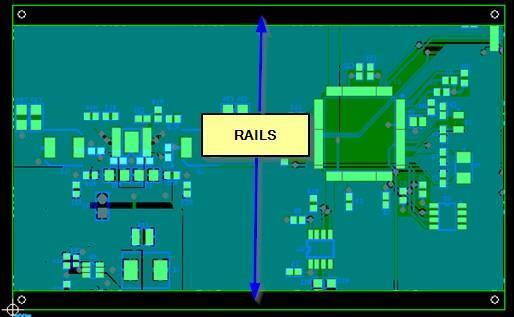
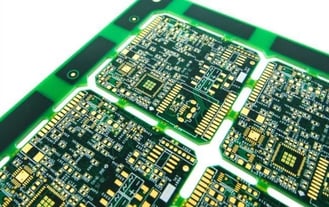 Even with single boards not in a panel, it's at times desirable to add rails or a frame to PCBs. These are to be used when:
- Parts bodies are less than 6mm to the board edge
- The board is not square or rectangle
- The PCB is designed with ridged/flex technology.
- Flex and rigid/flex are special cases. We would like to review the files prior to processing these types of designs.